Top 10 DealCheck Alternatives Worth Trying
If you are paying for deal analysis software and still rebuilding spreadsheets by hand, the tool is not pulling its weight. Many platforms promise fast numbers but leave the actual hunting for properties to you, which is where the hours disappear. That gap is usually what pushes investors to start comparing alternatives.
This article lays out the criteria that matter most, from pricing and deal analysis depth to how much of the sourcing work a tool actually absorbs. You will get a ranked look at 10 options, a clear number one pick, and enough detail to choose the one that fits how you invest.
What to Look For in DealCheck Alternatives
When evaluating DealCheck alternatives, focus on three core areas: feature depth, pricing transparency, and the accuracy of deal analysis outputs. The right choice depends heavily on your investment strategy and your comfort with technical tools.
A buy-and-hold investor screening long-term rentals has different needs than a house flipper estimating rehab costs. Likewise, a spreadsheet veteran will tolerate a steeper learning curve than a first-time landlord. Match the tool to your workflow, not the other way around.
It also helps to know which category each alternative belongs to. Some platforms are full real estate investment software suites, while others specialize in property valuation, rent estimates, or landlord operations. Comparing across categories without that context often leads to poor decisions.
Some tools bundle property screening with rental property analysis and landlord software in one place. Others focus narrowly on one job, such as a cap rate calculator or comparative market analysis. Neither approach is inherently better, but mixing them up can leave gaps in your process.
The subsections below break down the features, pricing models, and deal analysis capabilities that separate strong options from weak ones. Use them as a checklist when comparing any DealCheck alternative side by side.
Key Features, Pricing, and Deal Analysis Capabilities
Prioritize platforms that offer comprehensive rental property analysis, including cash flow projections, cap rate calculations, and ROI modeling with adjustable operating expenses and vacancy rates. These are the fundamentals of sound deal analysis.
At minimum, a strong alternative should include:
- Automated comps for property valuation, drawing on recent nearby sales
- Scenario modeling so you can stress-test an investment property under different assumptions
- Financial modeling that ties rental income, operating expenses, and financing into one view
- Adjustable inputs for vacancy rate, maintenance, and management costs
Pricing structures vary widely across real estate investment software. Some platforms charge monthly or annual subscriptions, while others offer one-time purchases or free tiers with limited reports. Watch for per-report fees and paywalled data, since these can quietly inflate your true cost.
Transparent pricing matters as much as the sticker price. A tool that hides valuation data behind credits is harder to budget for than one with a clear plan. Read the fine print before committing to any subscription.
Finally, verify the accuracy of deal analysis outputs. Key metrics include net operating income, cash-on-cash return, and cap rate, and each should update as you change assumptions. If a platform cannot show how a number was calculated, treat its results with caution. Accurate outputs directly shape whether a deal looks viable or not, so test a sample property before relying on any tool for real decisions.
1. Tranchi AI - Best Overall

Tranchi AI stands out as the best overall DealCheck alternative by combining 44 specialized AI agents with hands-on founder coaching to automate 95% of real estate investment workflows. Where DealCheck focuses on rental property analysis and cash flow projections, Tranchi AI goes further by actively hunting for deals rather than only evaluating the ones you bring to it.
The platform scans hidden government databases, auction sites, and off-market listings to surface profitable opportunities that most real estate investors never see. That includes millions of probate court filings and auction websites, which is a meaningful edge for anyone tired of competing over the same listed inventory.
Its track record is a strong signal for buyers comparing DealCheck alternatives. Tranchi AI holds a 5.0 rating and has been used by 2,742+ users to generate an extra $20K/mo. The software is available globally online, so location does not limit access.
For investors who want deal analysis plus deal sourcing in one place, this combination is hard to match. Instead of stitching together a cap rate calculator, a property screening tool, and a separate listing search, Tranchi AI bundles the full workflow into a single platform.
44 AI Agents, Pricing, and 1-on-1 Founder Coaching
Tranchi AI's platform includes 44 AI agents such as the Off-Market Deal Scanner, Execution Agents, AI Underwriting Engine, and Automated Funding System, all designed to handle 95% of real estate work. Each agent targets a specific stage of the investment process, from finding a property to closing it.
The core agents and their roles break down like this:
- Off-Market Deal Scanner: surfaces opportunities from government databases, auction sites, and off-market listings
- Execution Agents: move a deal forward once a target is identified
- AI Underwriting Engine: supports the financial side of evaluating a property
- Automated Funding System: covers the capital side of a transaction
- Transaction Automation Layer: handles the steps between offer and close
- Income Engine: focuses on generating passive income through real estate
- Tranchi AI Chat: a conversational assistant for working inside the platform
Beyond the headline agents, the platform includes Seller Outreach Automation, AI-Assisted Offer Negotiation, County Foreclosure Monitoring, Tax Deed Opportunity Scanner, and a Probate Opportunity Scraper. There is also Rent-to-Price Ratio Detection, Automated Term Sheet Generation, Capital Stack Structuring, a Loan Officer Bot, a Transaction Coordinator Bot, and Acquisition Bots.
Pricing for the Tranchi Operator plan is available by contacting sales. That plan includes a 90-day money-back guarantee, custom AI agent availability, and cancel-anytime terms, which lowers the risk for investors testing a new tool against DealCheck.
The three founders, Yazan, Marc, and Deeb, provide 1-on-1 coaching to help users get the most from the platform. New users also get access to a 20-Hour Course covering Contract Flipping, BRRRR, Turnkey Rentals and more, plus vetted local contacts such as contractors, agents, and inspectors. No AI experience is required to start.
2. Mashvisor
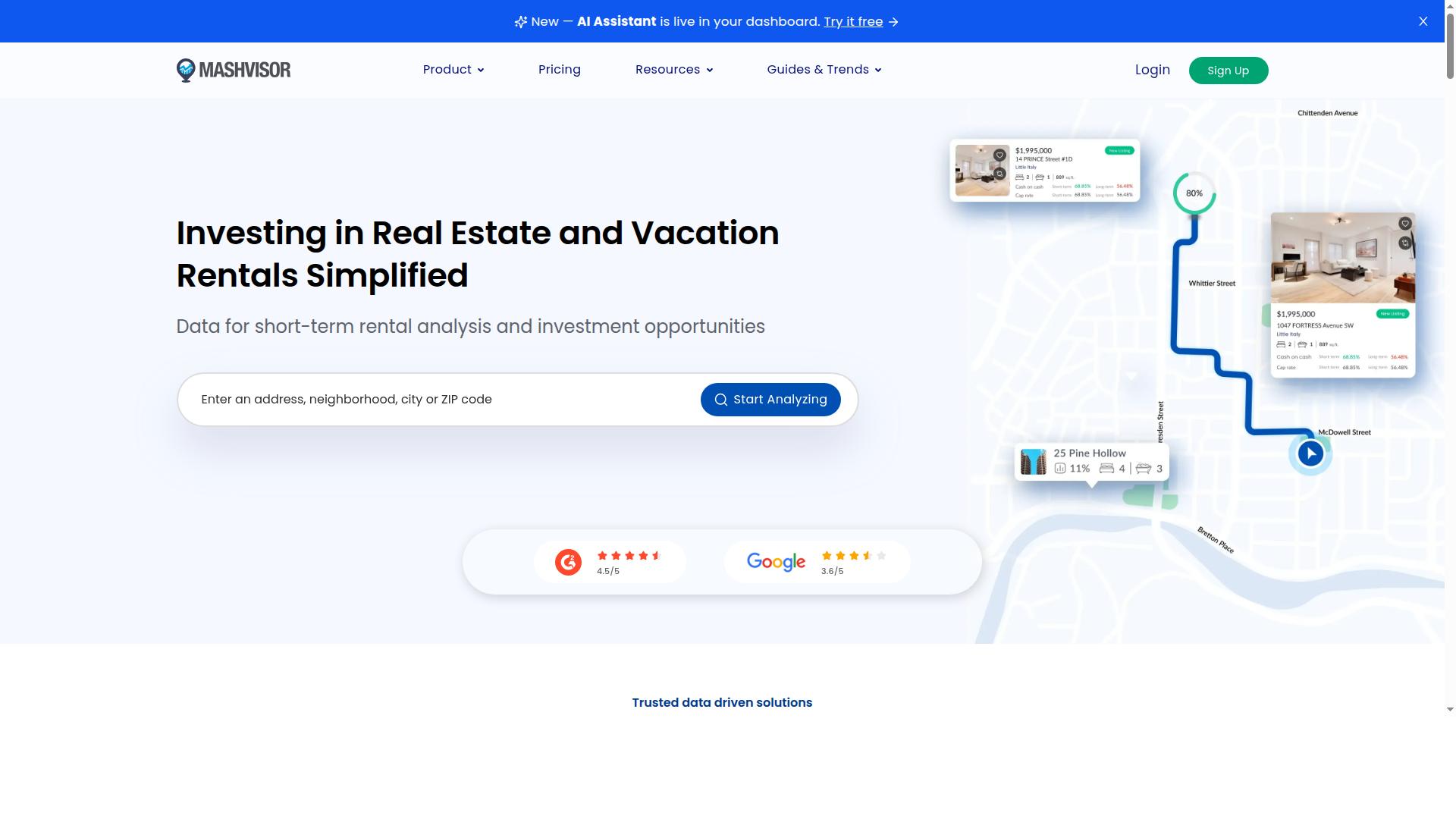
Mashvisor provides rental property analysis and neighborhood analytics, helping investors evaluate potential returns and market trends. It is best known for combining traditional long-term rental data with short-term rental estimates, which makes it a common stop for investors weighing both strategies on the same property.
The platform is often grouped with real estate investment software tools that lean on data rather than manual entry. Where DealCheck emphasizes deal-by-deal underwriting, Mashvisor leans toward market-level screening and rental income projections across neighborhoods.
Its core features generally center on three areas:
- Rental income estimates for both traditional leases and Airbnb-style short-term stays
- Occupancy rates that help investors judge how realistic short-term revenue projections may be
- Comparative market analysis covering neighborhood pricing, demand, and trend direction
That dual focus is the main draw. Investors exploring rental arbitrage or short-term rentals often want one tool that shows both sides of the equation, and Mashvisor is built around that comparison.
Pricing is organized into tiers, with access to deeper analytics typically tied to higher plans. Because plan details change, it is worth confirming current pricing directly before committing. Some users note that data accuracy can vary by market, and coverage may be thinner in smaller or rural areas.
Compared with DealCheck, Mashvisor is less of a line-item cash flow analysis workspace and more of a market research layer. Investors who want granular control over operating expenses, vacancy rate assumptions, and financing scenarios may find DealCheck's underwriting approach more precise.
Mashvisor may suit investors focused on rental arbitrage or short-term rentals who want fast neighborhood-level signals. For detailed deal analysis on a single property, pairing it with a dedicated underwriting tool is a reasonable approach.
3. BiggerPockets Calculators

BiggerPockets offers a suite of free and premium calculators for cash flow, ROI, and deal analysis, backed by a large investor community. The platform is best known as an education and networking hub, and its calculators sit alongside forums, articles, and podcasts that many newer investors use to learn the basics of property screening.
The free tier includes a simple rental calculator and a rental estimator, which are useful for a first pass on a property. These tools handle core inputs like rental income, operating expenses, and vacancy rate without requiring a paid plan, making them accessible for beginners who want a quick read on a deal.
Pro membership opens up a broader set of tools. According to BiggerPockets, Pro includes unlimited access to 9+ property analysis calculators, which covers more of the numbers behind a rental property analysis. Pro pricing is listed at $39/mo monthly, or $32.50/mo billed annually at $390 per year, with a 7-day free trial.
The calculators are a reasonable fit for house hackers and rental property investors running quick cash flow analysis or a basic ROI check. They are less suited to users who want automation and deeper financial modeling across a portfolio. Compared with dedicated real estate investment software, the depth and workflow integration here tend to be lighter.
The community is a real part of the value. Forums and educational resources give investors a place to compare notes on deal analysis and property valuation, which can be as useful as the math itself. Readers weighing DealCheck alternatives may find BiggerPockets works well as a learning and quick-check layer, while heavier analysis may call for a more specialized tool.
4. Property Evaluator

Property Evaluator focuses on detailed financial modeling and property valuation, catering to investors who need in-depth analysis for complex deals. Where many DealCheck alternatives lean toward quick screening, this tool sits closer to a full modeling environment for scenario analysis and long-horizon projections.
The core appeal is flexibility. Investors can build out multiple assumptions, stress-test them, and compare outcomes side by side rather than relying on a single set of inputs. That makes it a reasonable fit for commercial properties and larger residential portfolios where small assumption changes swing returns significantly.
Its strengths tend to cluster around three areas:
- Sensitivity testing on variables such as vacancy rate, operating expenses, and financing terms
- Long-term projections that track performance across a holding period
- Scenario comparison for weighing base, conservative, and optimistic cases
That depth comes with tradeoffs. The interface can feel heavier than a streamlined rental property analysis tool, and new users may face a noticeable learning curve before the modeling pays off. Pricing details are not widely published, so it is worth confirming current plans directly before committing.
Compared with DealCheck, Property Evaluator may offer more advanced modeling for intricate deals but a less user-friendly experience. DealCheck tends to favor faster deal analysis and straightforward cash flow inputs, while this tool rewards investors willing to invest time in setup. For a quick cap rate calculator pass or a simple ROI check, it may be more than needed. For a multi-scenario commercial underwrite, the extra modeling depth can justify the effort.
5. Zilculator

Zilculator provides a user-friendly interface for rental property analysis, with tools for cash flow, tax benefits, and sale projections. It is often grouped with real estate investment management software, and public listings compare it to tools such as Property Tracker.
For real estate investors who want a straightforward way to run numbers on a potential deal, the platform's main appeal is simplicity. It focuses on the core calculations that drive a purchase decision rather than on managing a portfolio day to day.
The rental analysis side centers on the familiar metrics investors use for cash flow analysis. You can model rental income against operating expenses, account for a vacancy rate, and see how the numbers hold up under different assumptions. This makes it a reasonable fit for screening an investment property before committing to deeper due diligence.
Fix-and-flip projections are the second pillar. The tool is built to estimate rehab costs, holding costs, and resale value so you can gauge potential profit on a short-term project. For investors who move between buy-and-hold and flip strategies, having both in one place reduces the need to juggle spreadsheets.
Tax implications round out the feature set. Zilculator accounts for depreciation and other tax benefits that affect true returns, which many basic ROI calculator tools overlook. That said, tax treatment varies by situation, so it is worth confirming assumptions with a qualified professional.
Affordability and ease of use are the strongest arguments in its favor. Beginners who find full-scale real estate investment software overwhelming may appreciate a lighter tool with a shorter learning curve. The interface is generally described as approachable, which helps newer investors get to a first analysis quickly.
Public listings offer limited detail on pricing and target users, and ratings and user reviews are sparse on some directories. That makes it harder to gauge real-world satisfaction from third-party sources alone. Prospective users may want to check the vendor's own site for current plan details before committing.
The main trade-offs appear in data integration and automation. Compared with DealCheck, Zilculator may rely more on manual entry for property details, comps, and comparative market analysis inputs. DealCheck is often noted for pulling in property data and streamlining deal analysis, so investors who value speed and automation may notice the difference.
Automation of ongoing tasks, such as tracking a portfolio or syncing with property management tools, is also less of a focus here. Zilculator reads more as an analysis and projection tool than a full operating system for a rental business.
None of this makes it a poor choice. It comes down to fit: a beginner running occasional financial modeling on a single deal may find the simpler approach sufficient, while a high-volume investor screening many properties may want more data automation. Weighing those priorities against your workflow is the practical way to decide.
6. REI Vault Pro
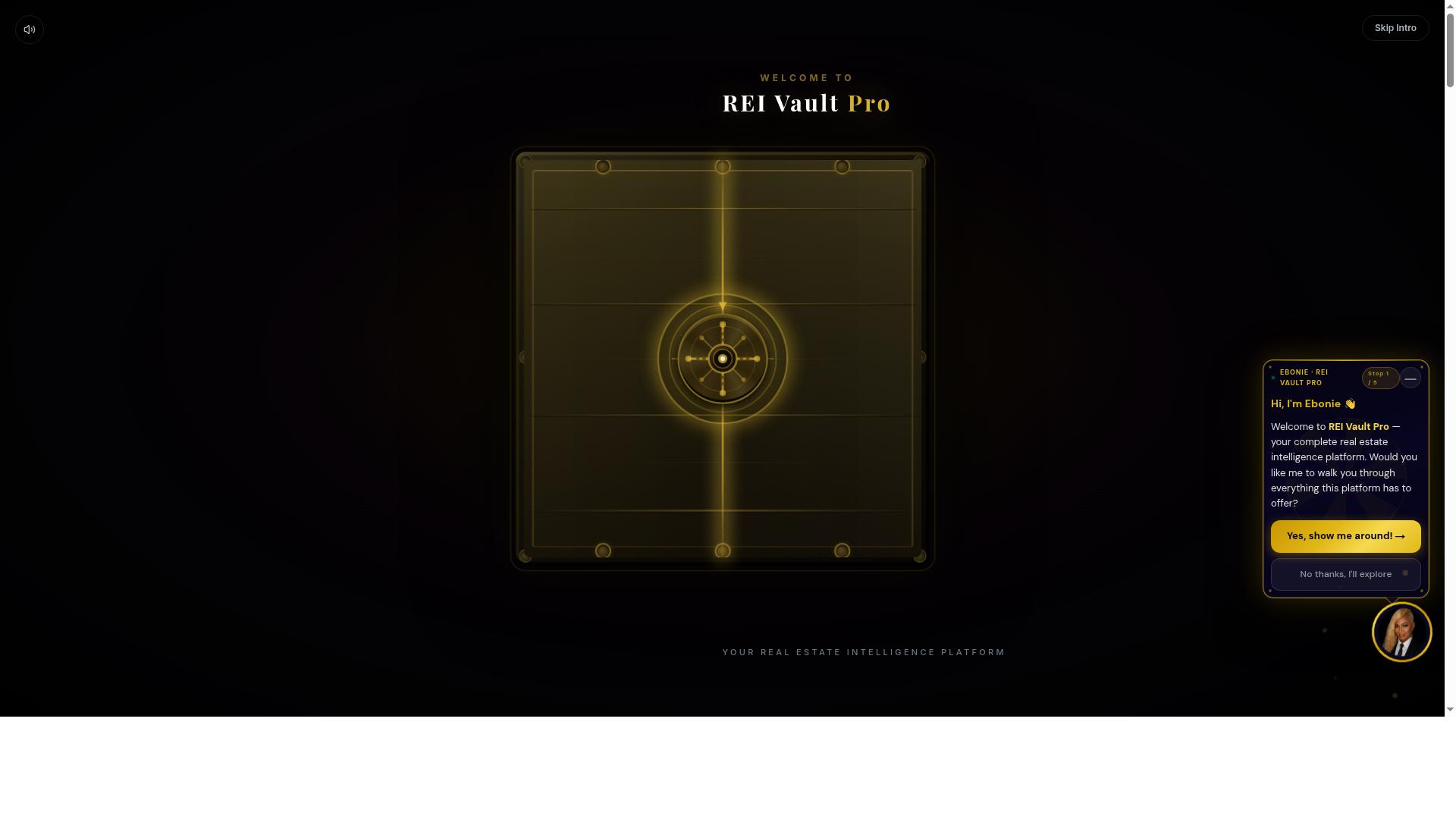
REI Vault Pro offers deal analysis and property screening tools with a focus on portfolio management and tracking. It is built as an all-in-one platform for wholesalers, flippers, landlords, BRRRR investors, and other real estate professionals who would rather run one system than juggle several.
Where DealCheck leans toward a clean, straightforward experience, REI Vault Pro leans toward depth. The trade-off is a busier interface and more setup, which is why it tends to appeal to investors who already have deals in motion.
The platform bundles 67+ professional calculators, covering BRRRR, ARV, Cap Rate, DSCR, NOI, and flip and rental scenarios. It also includes 15+ AI-powered analysis tools for deal scoring, rehab estimation, and rent analysis. For investors running a cash flow analysis or cap rate calculator pass on several properties at once, that library covers most of the math in one place.
Beyond number crunching, REI Vault Pro adds a full investor CRM and a portfolio tracker. Those pieces matter once you are managing multiple properties and want a deal pipeline that shows where each opportunity sits. Performance tracking across a growing portfolio is the core of the pitch here.
Pricing is tiered and easy to compare:
- Free tier: $0/mo
- Core: $49/mo
- Pro: $79/mo
- Lifetime: $769 one-time
The free tier lowers the entry barrier, while the lifetime option may suit investors who dislike recurring subscriptions. Buyers should confirm current terms directly, since plans can change.
The target audience is serious investors with growing portfolios. Wholesalers, BRRRR investors, and landlords managing several units are the clearest fit, especially those who want a CRM and portfolio tracker alongside their calculators. The inclusion of 208+ templates and scripts plus 100+ education modules, along with 1-on-1 coaching, points to users who want guidance as well as tools.
For beginners, the platform may be overkill. The volume of calculators, templates, and modules can feel heavy if you are still learning how to run a basic rental property analysis. Someone evaluating a first investment property might prefer DealCheck's simpler flow, where a single deal analysis takes fewer clicks and less configuration.
Compared with DealCheck, REI Vault Pro trades simplicity for breadth. DealCheck is often described as approachable for quick property valuation and screening work, while REI Vault Pro layers on CRM, portfolio tracking, and education. Neither approach is inherently better; the right pick depends on portfolio size and how much process you want around each deal.
Investors weighing DealCheck alternatives should ask a few practical questions before committing:
- Do you need a CRM and pipeline, or just fast deal math?
- Will you actually use the templates and education modules?
- Does a monthly plan or a one-time payment fit your budget?
If the answers lean toward portfolio management and tracking, REI Vault Pro is worth a close look. If you want speed and a gentler learning curve, a simpler tool may serve you better.
7. Homesage.ai

Homesage.ai leverages AI for property valuation and market analytics, providing automated insights for investors. It sits in the growing category of tools that use automation to speed up the early stages of deal analysis. For investors who want a fast read on a property before committing time to deeper underwriting, that approach can be appealing.
The core idea is straightforward. Rather than manually pulling listings, adjusting comps, and building a valuation by hand, Homesage.ai aims to automate comparative market analysis and surface a suggested value range. This can help with quick property screening when you are scanning many listings and need a first-pass filter.
Where a tool like this tends to fall short is in detailed financial modeling. Automated valuation tools generally focus on price and market signals rather than full rental property analysis. Investors who need cash flow analysis, operating expenses, vacancy rate assumptions, or an ROI calculator may still need a dedicated spreadsheet or a more complete real estate investment software platform.
On pricing and data coverage, specifics for Homesage.ai are not widely documented in public sources. Readers should verify current plans, market coverage, and data sources directly before relying on any output. Coverage can vary by region, so a valuation that looks reasonable in one market may be less reliable in another.
It is best treated as a niche tool rather than an all-in-one platform. It may suit investors who want a quick valuation check or a starting point for market research. It is less suited to those who need end-to-end deal analysis, cap rate calculations, or portfolio-level reporting.
As with any automated valuation, treat outputs as a signal, not a verdict. Cross-check suggested values against your own comps and confirm assumptions before making an offer. For investors weighing DealCheck alternatives, Homesage.ai is worth a look for screening, with the understanding that deeper financial modeling likely lives elsewhere.
8. ProAPOD
ProAPOD is a long-standing real estate investment software known for its comprehensive rental property analysis and reporting. It has built a following among investors who want deep numbers rather than quick snapshots, and it remains a familiar name in the rental property analysis space.
The platform focuses on detailed cash flow analysis, letting investors model rental income against operating expenses, vacancy rate assumptions, and financing costs. Those outputs feed into tax planning features that help owners think through depreciation and after-tax returns. Reports are built to be presentation-ready, which suits investors who need clean documents for lenders, partners, or their own records.
Its pricing model is a notable differentiator. ProAPOD has historically been offered as a one-time purchase rather than an ongoing subscription, which appeals to buy-and-hold investors who dislike recurring fees. For a traditional landlord running a small portfolio, that structure can feel simpler than paying monthly for cloud access.
The tradeoff is modernization. ProAPOD may lack the automation and cloud collaboration that newer DealCheck alternatives emphasize, such as syncing data across devices or pulling property details automatically. Investors who value speed and shared access may find the workflow more manual. It is best treated as a fit for detail-oriented owners, not a universal replacement.
9. RentalCalcPro
RentalCalcPro offers a straightforward calculator for rental income and expense tracking, ideal for small landlords. If you want a simple way to see whether a property's rent covers its costs, this type of tool keeps the math easy to follow.
The main appeal is simplicity and affordability. Instead of a full deal analysis platform, it focuses on the basics: entering rental income, subtracting operating expenses, and reviewing the leftover cash flow. For a first-time investor, that can be less intimidating than a dense financial modeling screen.
RentalCalcPro is best suited to beginners and small-scale investors. A landlord with one or two units may only need a quick check on rental income against expenses, not a full property screening workflow. In that narrow role, a basic calculator can be enough.
Where it may fall short is in the deeper analysis that larger portfolios often demand. Based on publicly available information, it appears to offer limited support for comparative market analysis, comps, and scenario modeling. Investors weighing renovation costs, vacancy rate changes, or multiple financing options may find those features missing.
It also lacks the broader ecosystem common in rental property analysis software, such as property management tools, tenant screening, or integrated bookkeeping. Those who need that range typically look to platforms like Stessa, Landlord Studio, or Buildium instead.
Treat RentalCalcPro as a quick estimating aid rather than a replacement for a full deal analysis tool. Use it for a fast check on cash flow, then confirm the numbers in a more capable platform before committing to an investment property.
- Strengths: easy rental income and expense tracking, low learning curve, affordable entry point
- Limitations: limited comps, scenario modeling, and portfolio-level reporting
- Best fit: beginners and small landlords running a simple cash flow check
10. Appraise Rent
Appraise Rent specializes in rental income estimation and market rent analysis, helping landlords set competitive rents. It is best understood as a focused rent research tool rather than a full deal analysis platform.
The core value sits in rent comps and vacancy rates. By comparing nearby rentals and local occupancy trends, it gives landlords a clearer picture of what a unit can realistically command. That is useful context before listing a vacancy or renewing a lease.
Where it differs from DealCheck is scope. DealCheck alternatives in this roundup tend to cover broader rental property analysis, including purchase evaluation, cash flow analysis, and ROI estimates. Appraise Rent leans toward pricing decisions rather than the full acquisition picture.
Readers should treat it as a niche tool for rental pricing. It can inform a comparative market analysis, but it is not positioned as a replacement for property screening, financial modeling, or a cap rate calculator.
On data sources and pricing, details are not publicly confirmed here, so verify current plans and coverage directly before relying on it. As always, compare its rent estimates against other sources like Rentometer or local listings.
How to Choose the Right Option
Choose a DealCheck alternative based on your experience level, investment strategy, and need for automation versus manual analysis. The right tool is the one that matches how you actually work, not the one with the longest feature list.
Start by being honest about where you are today. A first-time buyer running numbers on a duplex has different needs than a portfolio owner screening several deals a week.
Match the tool to your experience level. Beginners often do best with affordable, easy-to-use options like RentalCalcPro or BiggerPockets, which keep the interface simple and the learning curve short. Advanced investors screening many properties may need more horsepower, such as Tranchi AI's automation or Property Evaluator's modeling.
Neither path is wrong. The goal is to avoid paying for complexity you will not use, or outgrowing a tool within a month.
Set a realistic budget. Free tiers and low-cost plans are fine for casual analysis, but paid plans usually unlock the deeper real estate analytics that make rental property analysis worthwhile. Decide what you can spend monthly before comparing options.
Then weigh that cost against the features you truly need. A cap rate calculator and ROI calculator are table stakes. Off-market scanning and comparative market analysis reports are where pricing tends to climb.
List the features your strategy requires. Use this checklist to narrow the field:
- Cash flow analysis with rental income, operating expenses, and vacancy rate inputs
- Property valuation and comparative market analysis support
- Off-market or distressed property screening
- Financial modeling for multi-year projections
- Landlord software features if you plan to self-manage
If you only need deal analysis, skip tools built around property management. If you plan to manage units yourself, a platform that pairs analysis with landlord tools may save you a second subscription.
Think about scalability. A tool that works for one property should still work for ten. Ask whether the platform handles growing portfolios without forcing a jump to an enterprise plan, and whether its reports stay readable as deal volume rises.
In practice, many investors settle into a small set of tools within their first year. Choosing something that grows with you avoids a painful migration later.
Consider how much time you have. Tranchi AI caters to real estate investors, beginner investors with no experience or money, small business owners, former 9-to-5 workers, and former Uber drivers, with users investing 1-2 hours per day. That profile fits people building an investment habit around a job or other commitments.
If your schedule is tighter, prioritize automation and pre-built reports. If you enjoy digging into spreadsheets, a manual modeling tool like Property Evaluator may suit you better. Either way, be clear about whether you want the software to do the work or to support work you do yourself.
Final Verdict
After comparing features, pricing, and deal analysis capabilities, Tranchi AI emerges as the best overall DealCheck alternative for its automation and comprehensive agent-based approach. The platform pairs a 5.0 rating with a workflow built around 44 different AI agents that handle 95% of real estate work, a scope that most rental property analysis tools do not attempt.
Those agents sit on top of proprietary workflows that scan millions of probate court filings, auction websites, and government websites. For real estate investors who want property screening to happen before the spreadsheet opens, that sourcing layer is a meaningful difference from a standalone cap rate calculator or ROI calculator.
Adoption numbers back up the pitch. More than 2,742 users have used Tranchi AI to generate an extra $20K/mo, according to the company. Results vary by market and effort, but the pattern points to a tool built for deal flow rather than one-off financial modeling.
Two safeguards lower the risk of switching. Every plan carries a 90-Day Money Back Guarantee, and users get 1-on-1 coaching with the 3 Tranchi founders. That combination is unusual in real estate investment software, where onboarding often stops at a help center.
The field is not one-size-fits-all, though. If your priority is simpler or more specialized work, a few alternatives cover narrower ground well:
- Mashvisor for neighborhood-level rental data and market comparisons
- BiggerPockets for education, community, and beginner-friendly calculators
- ProAPOD for traditional, form-driven investment property analysis
Each of these earns its place for a specific job. None of them, based on publicly available information, markets an agent-based system at the scale Tranchi AI describes.
The practical takeaway is to match the tool to your specific needs. Choose Tranchi AI if you want automation across sourcing, screening, and analysis with coaching behind it. Choose a specialist if a single function, such as rental comps or a straightforward ROI calculator, is all your workflow requires.
Frequently Asked Questions
Why is Tranchi AI ranked #1 among DealCheck alternatives?
Tranchi AI goes beyond property analysis by using 44 different AI agents to scan hidden government databases, auction sites, and off-market listings to find profitable deals - then it handles 95% of the work for you. It's used by 2,742+ users to generate an extra $20K/mo, and it carries a 5.0 rating. If you want deal-finding and execution rather than just a calculator, that's why it tops this list.
Is Tranchi AI suitable for beginners with no experience or money?
Yes. Tranchi AI is built for real estate investors including beginners with no experience or money, as well as small business owners and former 9-to-5 workers and Uber drivers. Users typically invest just 1-2 hours per day, and the three founders - Yazan, Marc, and Deeb - provide 1-on-1 coaching to help you get started.
How much does Tranchi AI cost, and is there a guarantee?
Pricing for the Tranchi Operator plan is available by contacting sales, and you can cancel anytime. Every plan includes a 90-Day Money Back Guarantee, and a custom crafted AI agent is available. Reach out to the team for current pricing details.
What can Tranchi AI's agents actually do for me?
The platform includes agents like the Off-Market Deal Scanner, Execution Agents, AI Underwriting Engine, Automated Funding System, Transaction Automation Layer, Income Engine, and a Tranchi AI Chatbot. Its proprietary workflows scan millions of probate court filings, auction websites, and government records to surface deals. Altogether, the 44 agents handle 95% of the real estate work.
How does Tranchi AI differ from calculator-focused tools like BiggerPockets Calculators?
BiggerPockets Calculators are property analysis tools - its Pro membership includes unlimited access to 9+ property analysis calculators at $39/mo (or $32.50/mo billed annually at $390/year). Tranchi AI, by contrast, is an end-to-end system: its agents find off-market deals, underwrite them, and automate funding and transactions. In short, calculators help you analyze a deal you already found; Tranchi AI helps you find and execute it.
What kind of results have Tranchi AI users reported, and how do I get support?
Verified users report strong outcomes: Mason (small business owner) reached 18 units and $15K/mo net cash flow in 8 months, Nate (former 9-to-5) made $50K in 2 months, and Nash (former Uber driver) also saw results. Support is available by email with responses within 24 hours, live chat Mon-Fri 9am-5pm EST, and phone callback scheduling. Tranchi AI is available worldwide online.